Friday, 6 April 2012

Beware Tourists- Driving abroad this summer could get you in a lot of bother!


Whilst my team and I are expert motoring solicitors and know pretty much everything there is to know about driving offences, driving loopholes and strategies applicable to UK motoring law, I was surprised to discover just how much our motoring laws differ from those in other European countries.

Many will have heard by now about France’s introduction of a new mandatory law to carry a handheld breathalyser at all times in your vehicle. Handheld breathalyser devices can be purchased in this country or when in France. I was recently asked to comment on this and other European driving rules on BBC Breakfast. Here are some snippets from the research we did for the show:

     Documents

     In many European countries, is compulsory to carry a driving licence, car registration papers and insurance documents in the car .
     
     Children in cars

It is often obligatory that children under 18 who are less than 1.35 metres tall (although in some countries it’s 1.5 metres) must travel in an EU approved child car seat or raised booster seat. This applies to travelling in the front and back seats.

In Holland, a child under three may not be transported in a car without being strapped in to a seat.

Parking

Again, in Holland I was bemused to learn that parking is severely limited and strictly enforced, particularly in 
Amsterdam, where you can be fined or have your car towed away for illegal parking, or for failing to pay the necessary parking fee and displaying the ticket.

In some areas, signs marked 'I' and 'II' separated by a red diagonal stripe may appear. These mean no parking on the left on odd dates, no parking on the right on even dates!!. In cities, you need a cardboard disc to park in "blue zone" areas. These discs, placed on the dashboard, can be obtained at motor club offices, tobacco shops and police stations. There is no parking where the curb is painted black and white or yellow.

     Do you take American Express for that?

Watch out in Germany! Known for having a more relaxed speed limit on most roads, if exceeded, German police officers are allowed to collects fines on the spot for any minor motoring offence and drivers are allowed to pay cash and on their debit/visa card.

Warning triangles and High Visibility Vests

In many countries such as Austria, Belgium, France, Italy, Norway and Portugal and (and likely to become compulsory throughout the EU) vehicles must carry a warning triangle and a highway first aid kit at times.
In Germany you are required to place the warning triangle 100 meters behind your vehicle if it is disabled (200 meters on the Autobahn).

In France you must carry “high vis” vests – enough for every person in your vehicle. Watch out though because the vests and triangles must be accessible from within the vehicle and not in the boot! This motoring offence is relatively minor and punishable by a fine but still, unless you do your research, you could get stung by a gendarme looking to make some extra cash on his tour of duty, stopping an unsuspecting car marked, “GB” otherwise known as “mug!”

Visibility Vests are now also compulsory in Spain. The rules vary from country to country concerning number of vests required and whether they should be carried in the car or boot. Common sense suggests that there should be a vest for every occupant, and that the vests should be carried in the car, and put on before getting out.

Carrying a warning triangle is also compulsory in most European countries. In Spain, one only is required for non-Spanish registered vehicles but two are required for Spanish registered vehicles.

Income Related Speeding Tickets

Talking of fines, the worst country to get caught speeding in is Switzerland. The penalty for speeding depends on the amount by which the speed limit was exceeded and, for more major offences, an additional penalty linked to the daily net-income (‘DNI’) of the perpetrator can be imposed.

If you get zapped by a speed camera the police will send you the fine even if you live abroad. In Switzerland speeding is not a violation of a traffic code but a ‘legal offence’. If you fail to comply there is a good chance that an international rogatory (a formal request from a court to a foreign court for some type of judicial assistance) will be issued and you have to go to court in your home country. This is enforced by most countries, including all of Europe. Failure to comply can result in a warrant being issued for your arrest by your home country.

Some might say this level of penalty is deserved by someone convicted of such a high speed. Whilst this famous allegation of a record speeding fine of £1,000,000 was widely publicized, there are no further reports of the eventual outcome of this case. Unlike the Swiss millionaire who was forced to pay up! Not many of us will drive at these speeds or have this level of income so I probably wouldn’t lose too much sleep over it if you have an impending trip to Zurich!

It’s a “no-no to Tom Tom!”

In France and Germany, a GPS based navigation system which has maps indicating the location of fixed speed cameras must have the ‘fixed speed camera Points of Interest’ function deactivated. Radar detectors are prohibited even if not switched on. You can be fined as much as 1500 euros, have the device confiscated or even have your car impounded if found in possession of an offending device. So, use your Sat nav by all means but watch out for this one. Apparently you are not obliged to allow an officer to inspect your device if they stop you so policing of this motoring offence must be interesting!

Indicating

The law operating in Spain regarding the use of indicators on motorways is being strictly enforced. You risk being fined for not indicating before overtaking and again before pulling back to the nearside lane after overtaking.

Mobile Phones

Talking on cell phones when driving is prohibited by Spanish law. This includes talking in your car when pulled over to the side of the road. You must be completely away from the road.

Most European countries ban the use of a mobile phone while driving but in some countries, even holding a phone while behind the wheel of a car amounts to a defence.

My advice

If planning on driving while abroad, I would advise that you do some research on the country’s motoring laws before you go. Many motoring websites contain extensive advice about European driving laws. Don’t chance it by thinking they do things the same way as in the UK as the examples above hopefully show just how different our motoring laws are.

Check out the news story we posted last year about how speeding tickets can follow you back home if driving in Europe and get in touch with us if you require any advice on this or other motoring law issues. All initial enquiries are dealt with free of charge. 08000 85 27 84.

Wednesday, 4 April 2012

Can You Fall Foul Of The Law Teaching A Learner Driver?


We have recently received a few enquiries about the rules applying to New and Learner Drivers. If you are a parent about to embark on the road of teaching your child to drive, you are already probably tearing your hair out with the stress of hitting the imaginary brake every 5 minutes every time you go out and about on driving practice!

The last thing you want is to get in trouble yourself for not following the motoring laws applicable to provisional drivers.

Read below for essential tips for learner drivers and their supervisors
Can anyone supervise a learner driver?

A provisional licence holder may be supervised by a “qualified driver” for the purposes of a driving lesson. A qualified driver is someone who is at least 21 years old and who has held a full UK driving licence for at least 3 years. L-plates must be displayed on the vehicle and there must be a valid policy of insurance in force in respect of the vehicle. A learner driver must also refrain from drawing a trailer.

Unless the person supervising the learner driver is a registered driving instructor, they cannot charge for their services. This means that it is fine for a parent to sit in and supervise their child, but they cannot take money or money’s worth for doing so. This is interpreted very widely and any arrangement must not have a “commercial flavour”.
  
How do I become a qualified driving instructor?

As of 2005, the regulations require a 3 part examination to be passed in order to become a registered driving instructor and hence being able to charge for lessons. These 3 parts are:

  1.      the written examination;
  2.      the driving ability and fitness test; and
  3.      the instructional ability and fitness test.


The driving ability and fitness test and the instructional ability and fitness tests must be passed within 3 attempts each and within 2 years of passing the written examination. Your instructor licence will need to be displayed in the windscreen of the car when giving lessons. Once you have qualified, you will periodically be required to undertake a test of continued ability and fitness to give instruction.


What duties do I have when I am supervising a learner driver?

Anyone supervising a learner driver has a duty, when necessary, to do whatever can reasonably be done to prevent the learner from acting unskilfully or carelessly or in a manner likely to cause danger to others, and to this extent to participate in the driving. If there is an accident caused by lack of supervision, the learner could be charged with driving without supervision and the supervisor with aiding and abetting him, both of which are punishable by a fine. Similarly a supervisor can be charged with aiding and abetting a learner drink driving if they are supervising a learner driver whom they know to be intoxicated, the most serious penalty for which is a custodial sentence for both parties.

A supervisor is not allowed to use a mobile telephone when supervising a learner driver. This is punishable by 3 penalty points and a fine, just as if the supervisor had been driving the car. The only defence which is provided for a supervisor to use their mobile telephone when supervising a learner is if:

(a)   they are calling an emergency service on 112 or 999;
(b)   they are acting in response to a genuine emergency; and
(c)   it is unsafe or impracticable for the learner to cease driving whilst the call is being made.

This is a broad offence and includes sending text messages and using the internet, so it will very rare for this this defence to apply..


Monday, 13 February 2012

New Drug Driving Offence Looming?


The British Medical Journal (BMJ) has published a report that suggests People who get behind the wheel within a few hours of smoking marijuana may be almost twice as likely to cause an accident as those who are drug-free.


According to the report, 18 percent of drivers causing road deaths have traces of illegal drugs including cannabis in their system. At present, the offence of driving whilst unfit requires the prosecution to prove that the drugs (which can be legal and illegal substances) taken by the driver have caused him to be "impaired". 

Mike Penning, Road Safety Minister, has confirmed the Government is intending to introduce a new drug-driving offence and recently announced a panel of experts who will advise on the technicalities of introducing the new offence, including whether it is possible to set limits similar to the drink-drive limit. Drug screening devices are also being introduced into police stations around the country.

Jeanette Miller, Senior partner of specialist motoring law firm and aka "Miss Justice" said of the proposals: 

"In addition to analysing a defendant's blood for traces of drugs, a number of tests must be conducted by the Police in these cases, which means that it is rare for us to lose a case involving a drug driving allegation.I understand why the Government would wish to change the law to prevent this but am not convinced that a drug-drive limit is the answer."

A recent survey by road safety charity Brake and insurer Direct Line revealed that one in nine young drivers (11 percent) admitted to driving while on illegal drugs. Julie Townsend, Brake Deputy Chief Executive, said: “Tackling drug driving should be a top priority. This report highlights the danger posed by drivers who have smoked cannabis and adds weight to Brake’s calls for widespread testing and prosecution of drivers who selfishly risk lives by taking illegal drugs and driving."


Friday, 13 January 2012

Being Victim of Insurance Fraud May Be No Defence


Written by George Matthews and Jeanette Miller 

There has been recent press coverage of a potentially enormous insurance fraud . Hundreds of drivers took out policies with the sham company and are only now discovering that the fraudulent insurance company, Aston Midshires, was not in fact and insurance company at all. They were targeting young drivers in particular who often struggle to secure affordable insurance.  A major investigation is now underway by the police, Trading Standards and the Financial Services Authority.


So, what of the people who have taken out insurance policies with Aston Midshires?  Sadly, the insurance cover is not valid, and people who have innocently, and in good faith, paid for their cover, are committing the offence of driving without insurance  every time they drive.  The penalty for driving without insurance is 6 to 8 penalty points or a discretionary disqualification and a fine of up to £5,000.  If you have taken out a policy with Aston Midshires, then you should not continue to drive until you have taken out a new insurance policy with an authorised insurer.

A defence is available to charges of driving without insurance where restrictions on a policy can be argued to be unlawful and in only one other special situation, namely, if an employee uses an employer’s vehicle believing they were insured but the employer has failed to ensure that the employee was insured.  In this case the defendant must prove on the balance of probabilities (in other words more likely than not) that the vehicle did not belong to him and was not in his possession under a contact of hire or a loan and that he was using the vehicle in the course of his employment.  In addition, he must also show that he did not know or have reason to believe that there was no insurance in place for that vehicle.

Although it is unlikely to be considered a defence in the case of a fraudulent insurance policy, it is possible to run what is called a ‘special reasons’ argument.  There are 4 conditions which must be satisfied for a special reason to be found:
  1. The reason must be mitigating or extenuating circumstance;
  2. It must not amount to a defence;
  3. It must be directly connected to the commission of the offence, and
  4. The reason must be one that the court ought properly take into account when imposing punishment.

So what happens if I have had an accident and I had taken out insurance with Aston Midshires?  The Motor Insurers' Bureau (MIB) was established in 1946 as a private company limited by guarantee for the purposes of entering into agreements with the government to compensate the victims of negligence, uninsured and untraced motorists.  If you face a claim for compensation arising out of an accident that was your fault, the MIB will almost certainly agree to compensate the victim and seek reimbursement of any compensation paid from you if you are able to afford reimbursement.

If you are presented with a claim for compensation for injuries or damage arising from an accident when you were not insured, it is extremely important that you tell your opponent that you were not insured.  Whilst you may be prepared to pay compensation towards the victim, the MIB will have the legal aspects of the claim free of charge and minimise the level of compensation payable.  For more information about the MIB please visit their website www.mib.org.uk.

If you are a victim of this outrageous fraud and you face a charge of driving without insurance, or if you currently have a policy with Aston Midshires and don’t know what to do next, call us on our freephone number on 08000 85 27 84 for some free initial advice.

Saturday, 7 January 2012

S-Z of motoring law

S is for Special reasons

The punishments/sentences for motoring offences ranges from prison to mandatory disqualifications, penalty points and fines.

However, if the offence occurred due to a special reason, the Court have the discretion not to award the guideline penalty. A ‘special reason’ is a reason given to the Court as to why the offence was committed. This can include spiked or laced drinks in a drink driving offence, driving a very short distance, driving in an emergency and being misled in an insurance matter.

If a special reason is presented to the court and Magistrates accept your evidence, they can choose to depart from the mandatory minimum penalty for the offence and in some circumstances, whilst you could be found guilty of an offence, you could avoid penalty altogether.

T is for Totting up


When a person receives 12 or more penalty points on their driving licence they will faced with being penalised pursuant to the ‘totting up’ provisions. These direct the Magistrates to impose a 6 month driving ban. In some circumstances (where you have been banned for 56 days of more in the previous 3 years) you could face a longer ban of 1 year.

Although the Magistrates are guided to disqualify a person with 12 penalty points at Geoffrey Miller Solicitors we have achieved enormous success in retaining the licences of thousands of our clients by putting forward arguments of exceptional hardship.

The Magistrates should take into account an individual’s personal circumstances and the effect the disqualification will have upon them and innocent third parties. If the ban would have a serious detrimental effect upon the individual such as losing their job or losing their home or if it would have a devastating effect upon another person such as a dependant, the Court have the discretion not to impose the 6 month ban. In these circumstances they can either impose no ban which means that the individual will continue to have 12 points on their licence until some of the points expire.

In some circumstances the court will refuse to allow a totting up defendant to escape a ban completely and they may impose a shorter ban under the totting up provisions. If this is the case the driver will be required to serve the ban but at the end of it their licence will be wiped clean of penalty points. Whilst no driver wants to receive a ban, this can be a great way of limiting the damage where your points are fairly recent.

Alternatively, the Magistrates can also impose a shorter ban for the substantive offence. in this situation the individual will be required to serve the ban but at the end of it their licence will be returned with all previous penalty points still shown on it. This is often a good outcome for those driving for a living as it is effectively achieving an "extra life" in case of any more offences in the future whilst your licence still has points on it.


U is for driving whilst UNFIT through drink or drugs


Anyone proved to be driving or attempting to drive whilst unfit through drink or drugs commits a criminal offence which is dealt with in a magistrates' court. The arrest procedure is similar to when arrested for drink driving. However, when suspected of being unfit through drugs, a blood sample or urine sample can be required from you as breath test machines are unable to detect drug consumption.

In addition to proving that you were intoxicated by alcohol or drugs, the police will also have to prove that your driving was impaired and can rely on both forensic evidence of samples provided by you and the standard of your driving - such as erratic motoring manouvres.

The maximum sentence is six months in prison. There is a minimum driving ban of 12 months.


V is for V5 Registration Document


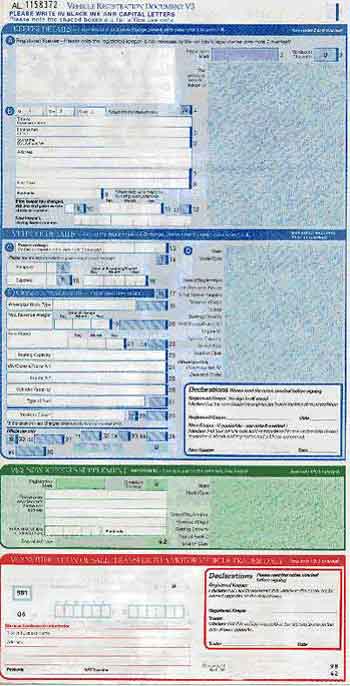
A V5 is the document issued by the DVLA (Driver and Vehicle Licensing Authority) to the keeper of a motor vehicle. It contains all of the information held by the DVLA about that vehicle. It is very important that the keeper of the vehicle makes sure that the records are correct and up-to-date by providing details of changes of address and by sending the relevant part of the V5 to DVLA when the vehicle is sold, scrapped or transferred to somebody else. The V5 used to be known as the Log Book.


W – is for WHEELS


Wheels are vital for all motor vehicles. Wheels have tyres on them and all tyres must have sufficient tread. Cars, light vans and light trailers MUST have a tread depth of at least 1.6 mm across the central three-quarters of the breadth of the tread and around the entire circumference. You can be given three points on your licence and a fine for not having enough tread. That is PER TYRE. So four bald tyres = 4x3 points = 12 points = a potential driving ban as a totter.


X – is for XYLOPHONE


There is no specific law preventing you from driving whilst playing a xylophone. However were you to be caught driving whilst playing a xylophone you could be prosecuted for driving without due care and attention or dangerous driving. We strongly suggest that you do not drive whilst playing your xylophone. If you feel the urge then you should pull over in a safe place.

Y is for YOUNG drivers

Young people are allowed to start driving or learning to drive most cars on their 17th birthday. 16 year olds can drive a mowing machine, a pedestrian controlled vehicle or a moped with an engine size of up to 50 cc and a maximum speed of up to 50 km/h. You have to wait until you are 21 to drive most larger vehicles. The rules are quite complicated. Check your driving licence or the DVLA website.


Z is for ZIZ ZAG lines

Zig-zag lines are painted on the road at pedestrian crossings and outside schools. You must not park on the zig-zag lines doing so is dangerous will land you with 3 penalty points and a fine.